Leave Your Message
So you're thinking about getting an aluminum louvered pergola in 2026? Good move, but it's not as simple as just picking one off the shelf. You gotta balance a few things: how well it manages shade, how it stands up to the elements, how it looks, and whether you'll be constantly fixing it. Honestly, the louvers are the star of the show – they should spin nice and smooth and close up evenly. You don't want those awkward gaps letting the sun or rain sneak in right above your dining table. And here's the kicker: always read the fine print. Check the frame alloy, wall thickness, the coating, drainage paths, and what the hardware is actually made of – because cheap materials will bite you later. Hey, you really should ask how the system handles wind and snow loads at your spot. Don't just take a vague 'all-weather' label at face value—seriously, the specifics are what matter.
You know, it's easy to get caught up in those glossy product photos, but a really careful comparison goes way deeper than that. I mean, you've got to double-check things like the actual opening dimensions, where the posts are going to sit, what kind of foundation it needs, and how much power it'll draw. And don't forget about whether it might mess with your existing drainage or lighting setup—that's a big one that people often miss. When you're talking to the seller or manufacturer, don't be shy about asking for the current drawings, the warranty exclusions (yeah, the fine print), maintenance guidelines, and any test documentation they have. Here's the thing though: ratings don't mean squat unless the conditions they were tested under match what you're planning to do. That part, honestly, gets overlooked all the time. So take your time, ask the right questions, and you'll avoid some nasty surprises down the road.
Look, if you're putting a pergola on a narrow patio, you'll need different support spacing than if it's spanning a wide deck. And sure, aluminum means less upkeep overall, but don't think it's totally maintenance-free—you'll still want to check the moving parts, finishes, and drains every now and then. Also, when you're budgeting, don't just compare the frame price; factor in the total installed cost, and it's always a good idea to get advice from someone who knows your specific site. One thing they don't tell you in the brochures: they never show how a pergola actually feels when it's raining sideways or on a sticky summer afternoon. At the end of the day, the right choice isn't the one that's got the most bells and whistles. It's the one that actually fits your real situation—like, its documented limits, controls, and support services. That's what really counts.
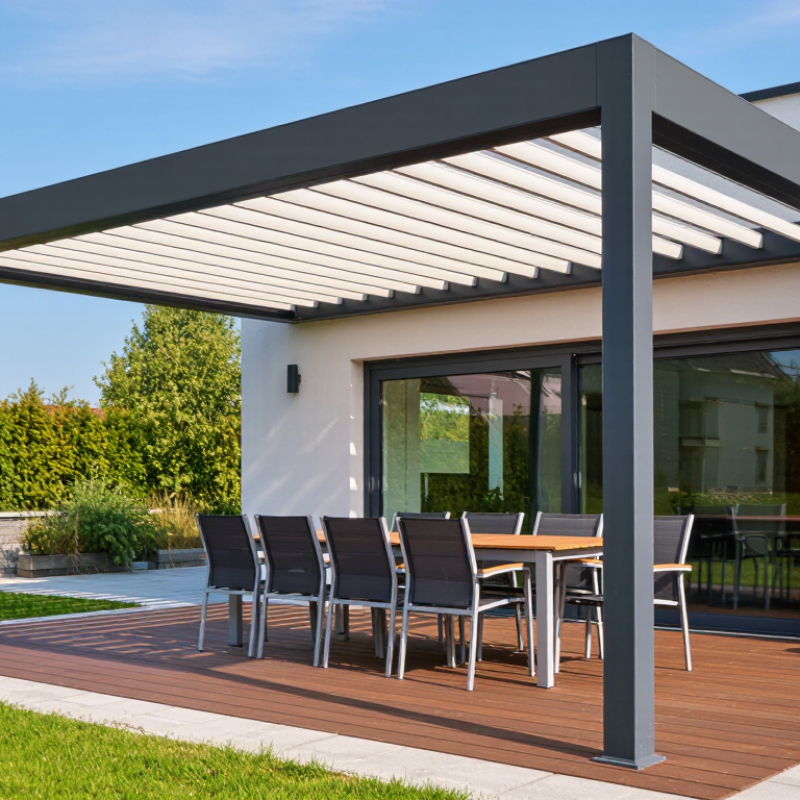
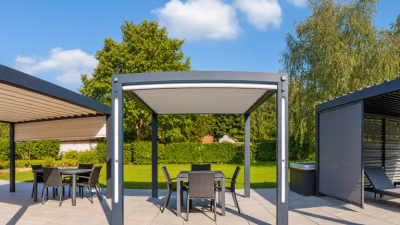
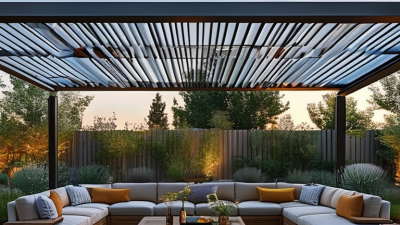
An aluminum louvered pergola is an outdoor structure with adjustable roof slats, called louvers. A control handle or motor tilts them together. Open slats admit sunlight and moving air; angled slats create shade while preserving some ventilation. When the louvers close, they form a roof-like surface. Not a sealed room.
Rain handling depends on the design. Many systems guide water into channels in the frame, then down through posts. This can keep a patio drier, but it does not guarantee a watertight space in every storm. Wind-driven rain may still enter at the sides, and water needs a clear route away from the base. Check the drainage path before installation.
The angle is the useful part. On a bright afternoon, a small adjustment can reduce glare on a table without darkening the whole area. Motorized models may include rain or wind sensors, but sensors are not a substitute for checking local weather and the product’s operating limits. Manual systems are simpler, though repeated adjustment can become inconvenient. It is easy to focus on the moving roof and overlook posts, footing, and maintenance. Those details matter, too. Keep channels clear of leaves, and inspect moving parts periodically.
| Selection Dimension | What It Is | How It Works | What to Check Before Buying |
|---|---|---|---|
| Structure and material | A freestanding or attached outdoor structure with an aluminum frame and a roof made of adjustable slats, called louvers. | Aluminum is relatively lightweight and forms a protective oxide layer when exposed to air. Finishes such as powder coating add color and another protective surface layer. | Ask for the frame alloy, finish details, warranty terms, and care instructions. Aluminum is corrosion-resistant, but it is not immune to damage or corrosion in every environment. |
| Adjustable louvers | Parallel roof blades that rotate between an open position and a closed position. The available movement varies by design. | Opening the blades admits more daylight and airflow. Closing them creates a more sheltered roof; it does not make every pergola fully weatherproof. | Check the adjustment range, whether louvers can be positioned at intermediate angles, and whether the control is manual or motorized. |
| Rain management | A roof system that may include shaped louvers, perimeter gutters, and downspouts. | When the louvers are closed, water is directed toward the roof edges and, on systems designed for it, into gutters and downspouts. | Ask where water exits, whether gutters and downspouts are included, and how the system performs in wind-driven rain. Review installation and maintenance requirements. |
| Operation and controls | Louvers may be operated by a hand crank or an electric motor, depending on the model. | Motorized systems rotate the blades using a powered actuator and are commonly controlled by a switch or remote. Some systems offer optional sensors or smart controls. | Confirm the power requirements, control method, manual operation options, and what happens during a power outage. Treat sensors and smart-home features as model-specific. |
| Size and layout | Available dimensions, post locations, and attachment options depend on the product and site. | The frame and supports transfer roof and environmental loads to the ground, a supporting structure, or engineered footings. | Measure the usable area, overhead clearance, door and window locations, and post positions. Have the proposed layout checked against local building requirements. |
| Wind and snow performance | Load capacity is specific to the structure, installation, and tested or engineered configuration. | Wind and accumulated snow place different forces on the roof, frame, connections, and foundations. A rating for one configuration does not automatically apply to another. | Request documented wind and snow-load information for the exact model and installation. Follow local codes and the manufacturer’s guidance on opening louvers or clearing snow. |
| Site and installation | The pergola can be installed in different Outdoor Settings, but its suitability depends on the site and support conditions. | Secure anchoring and correct alignment help the structure function as intended. Attached installations also need a suitable connection to the building. | Check ground conditions, drainage, utilities, wall construction, exposure, and permit requirements. Use qualified installers when required by local rules or the product instructions. |
| Care and longevity | Routine inspection and cleaning help maintain the frame, finish, moving parts, and drainage paths. | Leaves and debris can obstruct gutters or moving components. Cleaning and periodic checks help identify wear, loose fasteners, or coating damage. | Review the care schedule, cleaning products allowed, replacement-part availability, and warranty coverage. Avoid assuming that aluminum requires no maintenance. |
| Choosing for your needs | The best configuration depends on how you use the space, local weather, budget, and installation constraints. | A louvered roof offers adjustable shade and ventilation, with rain protection dependent on the design and conditions. | Compare verified specifications, drainage design, controls, installation scope, and local approvals—not appearance alone. |
Specifications and performance vary by model, installation, and local conditions. Verify all ratings and code requirements for the exact Pergola Configuration.
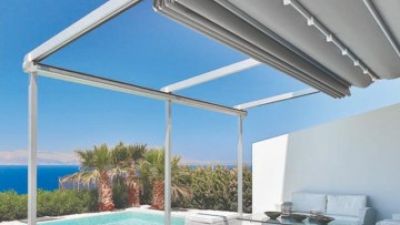
A commercial retractable PVC roof pergola offers a practical way to make outdoor areas adaptable rather than permanently shaded. NOAA’s 2023 U.S. Billion-Dollar Weather and Climate Disasters report recorded 28 weather and climate events that each caused at least $1 billion in damage, underscoring the value of outdoor structures that can respond to changing conditions. Non-rusting aluminum guide tracks extend from a building at an angle, while anchored posts provide support. Small cross-supports and fabric guides keep the roof taut, creating a clean, lattice-like profile.
Unlike fixed polycarbonate or timber covers, the retractable roof can open to bring in daylight and airflow or close for shelter. Its PVC fabric is specified as 100% waterproof, fireproof, and UV-proof, helping protect commercial patios and other outdoor spaces from sun and rain. Multiple modular panels can be installed side by side to create a continuous, gapless covering. Operation is available by manual crank or electric remote control, so users can adjust the shade to suit the weather; the manual option also works without a power supply. As a China-based supplier and factory, we provide this design for projects seeking flexible, durable outdoor coverage.
Compare alloy, wall thickness, joints, and finish. Color alone tells you little about strength.
No. Aluminum is lightweight and resists rot, but thin sections or weak connections can still flex.
Ask for wind and snow-load ratings for the complete structure. Ratings for separate parts may not describe the assembled pergola.
Check adjustable angles, smooth movement, clear drainage, and motor access. Ask how the louvers work during a power failure.
Measure the patio and note nearby doors, windows, and drainage paths. A level concrete slab may simplify mounting.
Yes. They may need extra structural assessment. Ask how posts will be anchored and where rainwater will flow.
Request separate costs for materials, labor, delivery, foundation work, and wiring. Compare the listed work, not just the final total.
Ask what happens if workers find uneven paving or hidden utilities. A vague estimate can leave important questions unanswered.
Yes. Contact your local building department about size, load, setback, and neighborhood rules. Keep written guidance.
Confirm who handles permits, then request the schedule, warranty terms, and care instructions. I might still miss a detail, so review them carefully.
Choosing an Aluminum Louvered Pergola begins with understanding how its adjustable roof works: the louvers can open to admit sunlight and airflow or close to provide shade and help manage rain. Before selecting a model, consider the size and orientation of your outdoor space, your local climate, and how you plan to use the area. Compare frame construction, louver strength and range of movement, and features that make adjustment convenient.
Also assess how the pergola handles water, including its drainage design and protection from wind and other weather conditions. Installation requirements, total costs, and any local building or property rules may affect which option is suitable. Finally, review warranty coverage and the supplier’s experience, product information, and support. Weighing these factors together can help you choose a pergola that fits your space, intended use, and long-term expectations.